13 DIY Projects To Spruce Up Any Room
You don’t need a sprawling house or a big budget to create a space you truly love. No one understands this better than Alexandra Gater, a former home editor at Chatelaine who now shares renter-friendly hacks, DIY projects and joyful makeovers with her 900,000 YouTube subscribers. She’s made it her mission to make home design accessible and prove that small updates can make all the difference.

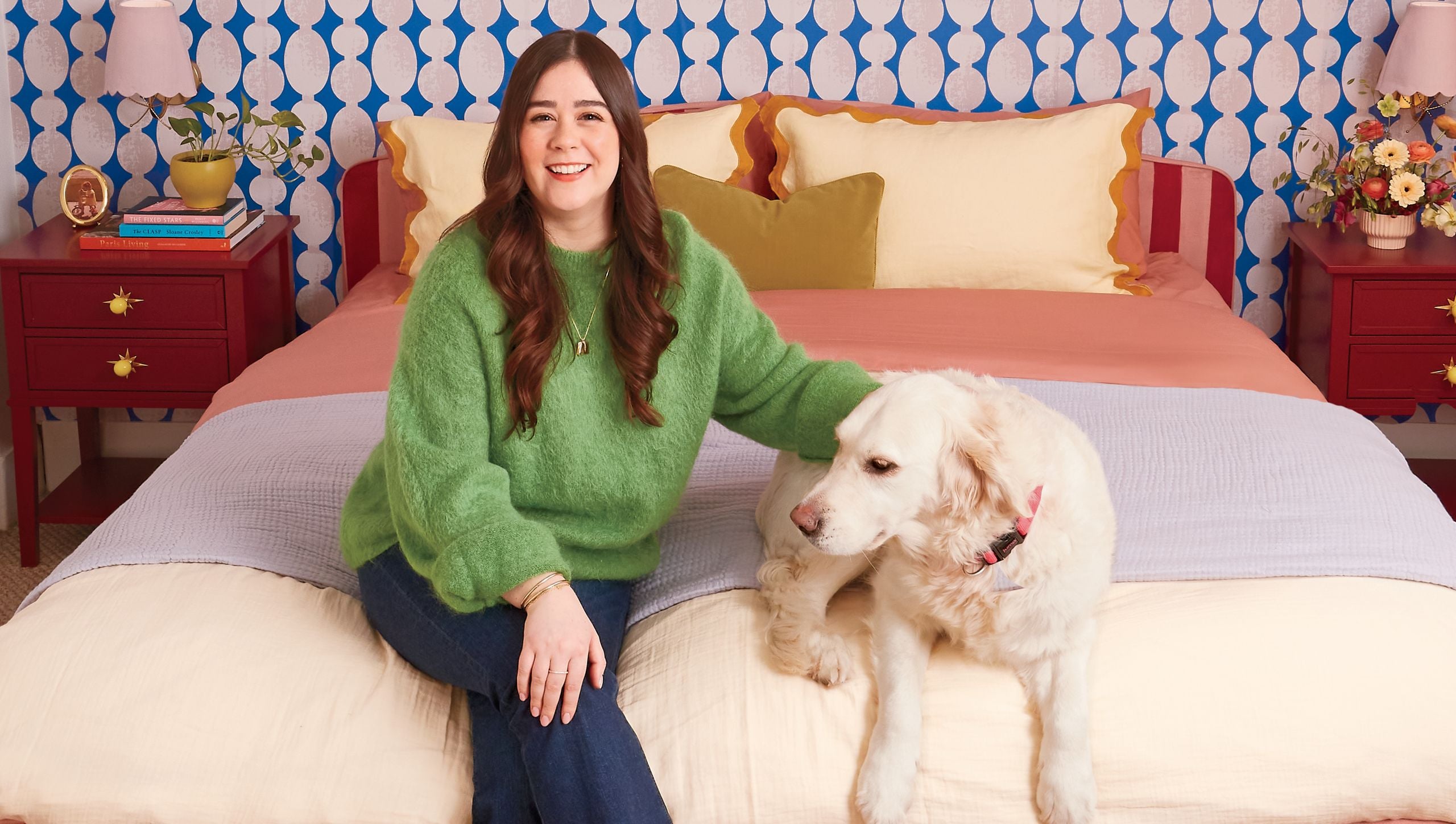
When we started planning this DIY extravaganza—featuring a makeover of our editor-in-chief Maureen Halushak’s bedroom—we asked Alexandra, who is also the author of the decor book Own Your Space, to step in as a guest editor. Here, she shares tips for creating big changes on a shoestring budget, and gives us a behind-the-scenes glimpse at how she pulled together a cozy, maximalist retreat without a big reno.
Wall sconces | Painted bed frame | New hardware | Easy printed art | Peel-and-stick wallpaper | Peel-and-stick tiles | Custom moulding | Furniture legs swap | Wallpaper border | Fringed sofa | Contrast trim | Colour-drenched ceiling | Ceiling medallion

Want to shop the look?
Wallpaper, thisisottostudio.com. Canvas art, studiovreeken.nl. Light fixture, mitzi.com. Bed frame and cover, ikea.com. Bedding, silkandsnow.com. Scalloped pillowcases, bedthreads.com. Pillow inserts, canadiandownandfeather.com. Rug, rugsusa.com. Nightstands, Three Posts via wayfair.ca. Knobs and backplates, matildagoad.com. Sconces, Passica Decor via amazon.ca. Linen lamp shade covers, carlyhome.com. Flowers, courtesy of Euclid Farms.
DIY Project #1: Light up your room without hardwiring [Beginner]

Love the look of sconces but don’t have any hardwiring or outlets nearby? Alexandra has a genius hack to bring a little glow to a dark corner. “I love rechargeable LED bulbs—they screw into the base of sconces like regular bulbs, and you can change the colour and brightness with a remote.”
For Maureen’s room, Alexandra found a set of easy-to-install sconces that came with battery-operated bulbs. To add more colour, she slipped custom-made scalloped covers from textile company Carly Home over the existing lampshades.
Pro tip
If your style leans eclectic, explore thrift stores for unique vintage lampshades that fit your sconces.
Materials
Sconces, rechargeable bulbs, drill, decorative lampshades (optional)
Steps
- Install the base of the sconces as directed.
- Charge the LED bulbs, screw them in.
- If desired, install new decorative lampshades. Or, take inspiration from this project and have custom shade covers made.
DIY Project #2: Cover up a plain bed frame [Advanced]

Maureen’s IKEA RAMNEFJÄLL bed frame's basic beige hue didn’t fit the maximalist vibe of the room. Rather than replace it, Alexandra transformed it with a bold DIY bed cover. The removable fabric slip—available at IKEA for just $60—was painted with rich red and pink stripes for a show-stopping moment that pulls the whole room together.
Pro tip
If painting fabric feels a little too advanced, check out Bemz, a company that makes patterned fabric covers for popular IKEA pieces.
Materials
Fabric bed frame cover, 1 quart paint of each colour, 1 L fabric medium, angled paint brushes (2-in. and small detail brush), painter’s tape, drop cloth
Steps
- Test painter’s tape to ensure it sticks to fabric. Cover floor with a drop cloth. Slip the cover onto the bed frame.
- Mix one-part paint and one-part fabric medium, using containers with lids to keep paint fresh between steps.
- Paint entire bed frame cover with two coats of the lighter paint mixture, waiting for it to dry completely between coats.
- Measure and tape the lines, starting at the centre of the bed frame and working outwards. (We used two widths of painter’s tape to get evenly spaced stripes.)
- Paint the lines with two coats of the darker paint mixture, waiting for it to dry completely between coats.
- Remove tape. Touch up paint where necessary. Let dry for 24 hours.
DIY Project #3: Pull your decor together with new hardware [Beginner]

Trading builder-grade hardware for funky knobs or pulls will instantly make a piece of furniture feel brand new. “It’s like adding jewellery to a boring outfit,” says Alexandra.
She recommends finding hardware that fits the pre-drilled holes of your furniture. If you’re adding hardware to a piece that doesn’t have pre-drilled holes, use a template kit (which is easily found online).
Pro tip
“A decorative backplate is an extra detail that goes a long way,” says Alexandra.
Materials
New knobs or pulls, screwdriver, bolt cutters (optional), extra washers (optional)
Steps
- If the new hardware fits into the existing holes, screw in the knobs as directed by the manufacturer. (If the screws are too long, you can shortening them with bolt cutters.)
- If a knob feels loose or sits crooked, add an extra washer to the back to help stabilize it.
DIY Project #4: Print a new art collection [Beginner]

There’s nothing like large-scale art to make a room come to life. To get gallery-worthy pieces on a budget, Alexandra swears by digital art, which many artists sell for a fraction of the cost of original paintings. She then gets the downloadable files professionally printed. And you don’t need to go to a fancy printing store—she uses Walmart’s Photo Centre for all her DIY projects.
“Art is how you make a space personal,” says Alexandra. “Hanging a generic piece on the wall because it matches the rest of your decor is not the way to go—if you find something you really love, that’s what makes a space more interesting.” Etsy and Minted are great places to explore different art styles and discover independent local artists. You can also find free, open-access art through museum collections online.
One common mistake? Going too small. For a single piece of art hung above a bed, sofa or fireplace, Alexandra recommends finding a piece that is 60 to 80 percent of the width of the furniture below.
Pro tip
Instead of framing your piece, get it printed on canvas to make it look like an original painting. Bonus points if it’s a digital print of an oil painting!
Materials
Downloadable art file, frame, picture-hanging kit or adhesive strips, drill or hammer
Steps
- Download your files and have your art printed. Alexandra recommends opting for matte paper so it looks less like a printout. If you’re going for an eclectic look, thrift your frames first—then print your art to fit the frames you have.
- Frame your prints and hang them using a picture-hanging kit or adhesive strips.
DIY Project #5: Add pattern play with easy-peasy wallpaper [Intermediate]

“Peel-and-stick wallpaper changed the decorating game for me,” says Alexandra, who has been using this DIY hack in rental apartments for years to bring in colour and pattern without the hassle or commitment of traditional wallpaper.
Her number-one tip to make the process as easy as possible? Have a friend help out with the installation.
Pro tip
Wallpaper is a great way to visually divide an open space, whether it’s a dining room nook or an office corner.
Materials
Peel-and-stick wallpaper, sandpaper (optional), isopropyl alcohol to clean, laser level, smoothing tool, utility knife, metal straight edge, ladder or step stool
Steps
- Calculate the amount of wallpaper you need to order. Walls are often a little crooked, so order for the largest measurement you find for each wall.
- Remove outlet covers and switch plates.
- Wipe the wall with isopropyl alcohol to remove dust and debris for better adhesion. If you want to go the extra mile, lightly sand the wall before cleaning it to ensure a smooth adhesion.
- Using a laser level, line up your first panel, leaving around two inches of excess material at the top. It’s especially important that the first panel is straight as you’ll be using it as a guide for the rest of the project.
- For each new panel, align the pattern with the previous panel. You’ll want to overlap by about half an inch to avoid gaps.
- Have one person remove the back of the peel-and-stick wallpaper while the other smooths the paper down onto the wall with a smoothing tool.
- Once all the panels are installed, use your utility knife and the metal straight edge to cut off the excess.
DIY Project #6: Tile out your space [Intermediate to advanced]

An outdated backsplash or floor can make a room feel more drab than it actually is, and it can clash with the decor style you’re trying to achieve. Enter peel-and-stick tiles, an easy way to spruce up a kitchen or bathroom on a budget.
Alexandra loves Canadian brand SmartTiles for backsplashes. It offers a wide range of options, from classic white subway to intricate colourful patterns. She recommends WallPops for peel-and-stick flooring.
Pro tip
Apply silicone around the edges of your peel-and-stick backsplash to seal out moisture and hide uneven cut lines.
Materials
Peel-and-stick tiles, ruler, pencil, utility knife, isopropyl alcohol to clean, silicone to caulk
Steps
- Measure the surface. Make sure to order enough tiles.
- Wipe the backsplash or floor with isopropyl alcohol to remove dust and debris for better adhesion. Remove outlet covers and switch plates.
- If using patterned tiles, lay them out to visualize the pattern first. (For flooring, start at the centre of the room, making sure the first tile is perfectly centred—it will serve as your guide.)
- Where partial tiles are needed, mark the back with a pencil and use a ruler and utility knife to cut.
- Align the tiles, remove the backing and press firmly onto the wall or floor.
DIY Project #7: Think outside the box with chic mouldings [Intermediate]

A little moulding goes a long way to make a basic white room feel warm and elevated. And you don’t need carpentry skills to get the look—you can order a peel-and-stick wall moulding kit online. “I’ve used this in countless makeovers,” says Alexandra. “It’s my favourite trick to make it feel like you’ve just moved to Paris.”
Pro tip
Add caulk to the edges of the paneling and paint it the same colour as your wall to make the moulding look like an original detail.
Materials
Peel-and-stick moulding kit, measuring tape, laser or bubble level, isopropyl alcohol to clean, caulk, paint (optional)
Steps
- Check the moulding kit’s instructions. The adhesive may not work on certain paint finishes.
- Wipe the wall with isopropyl alcohol to remove dust and debris.
- Figure out the placement. Alexandra maps it out on paper and uses painter’s tape to outline where mouldings should go before installing.
- When happy with the placement, use a level to ensure each piece of moulding is straight, then remove the backing and press firmly onto the wall.
- Caulk the edges of the pieces. Paint, if desired.
DIY Project #8: Give your furniture a leg up [Beginner]

Swapping out your furniture’s builder-grade legs is an easy DIY project that makes a big impact. “It will instantly add visual interest to your space,” says Alexandra, who often uses this hack to bring in subtle pops of colour or playful silhouettes to her makeovers.
Pro tip
To update your IKEA furniture, Alexandra’s go-to is Pretty Pegs, a company that sells legs that fit many of the retailer’s bestselling pieces.
Materials
New furniture legs, universal fitting plates (if needed), screwdriver or drill, felt pads
Steps
- Build your furniture, if required. (For this hack to work, the existing legs of your piece need to be screwed on separately.) Flip it over.
- If your new legs fit into the existing leg holes, simply screw them in.
- If your piece of furniture doesn’t come with legs, or if the new legs don’t fit the existing holes, install the universal fitting plates with a screwdriver or drill. (When buying universal fitting plates, make sure their thread size matches the bolts on your new legs. This will be indicated on the package or online listing.) Once the plate is secure, screw the bolt of the new leg into the plate.
- Add felt pads to the bottom of the legs to protect floors.
DIY Project #9: Embrace a retro wallpapering hack [Intermediate]

Don’t feel like wallpapering an entire wall—or an entire room? Alexandra suggests embracing the wallpaper border, which you may remember from the ’80s and ’90s.
“It makes such an impact, without the commitment—or price—of wallpaper,” she explains. “It’s a great, low-lift way to add a playful touch to your room.”
Pro tip
To make this project renter friendly, opt for a peel-and-stick wall- paper border.
Materials
Wallpaper border, laser level and pencil (optional, depending on placement), isopropyl alcohol to clean, smoothing tool, utility knife, ladder or step stool
Steps
- Calculate how much trim you need. Plan for an extra 2-to-3 in. per wall.
- Follow the steps for peel-and-stick wallpaper (above), positioning the border to follow the ceiling or level line. If your border comes in multiple strips, overlap strips by about 1/4-in. to avoid gaps; be sure to align the pattern.
DIY Project #10: Bring on the fringe benefits [Beginner]

To inject personality into a room without breaking the bank, Alexandra loves to incorporate vintage-inspired fringe details. “Texture and layering with tactile elements like rich fabrics and embellishments is key in design because it adds depth and dimension,” she explains. “A simple fringed trim can transform an everyday piece of furniture into something fun and full of character.”
Fringed furniture is often vintage or high-end, notes Alexandra, meaning it can be costly. Her DIY workaround? A simple fringed trim that costs under$10 per yard and gives any sofa a luxurious and cozy feel. This hack is especially well0suited to maximalist decor—think lots of colours and clashing patterns—but it can also be used to bring softness to contemporary spaces.
Pro tip
Choose a fringe in the same colour family as your sofa to make it built-in.
Materials
Decorative fringe trim with a 1-in. band at the top for stapling (from a fabric store or Etsy), staple gun
Steps
- Build the sofa, if required. (Note: This hack will only work for pieces of furniture with a wooden frame.)
- Measure each side of the sofa to calculate the length of trim needed. Alexandra recommends adding trim to the back of the sofa even if you can’t see it for a more polished look.
- Flip the sofa over and locate the wooden frame. (You should be able to feel it through the fabric.) Lay the band of the trim over the frame of the sofa so that the tassels hang over the edge.
- Pull the fringe taunt as you staple the band of the trim into the frame of the sofa every inch or so. (Another set of hands is helpful for this step.)
DIY Project #11: Make your trim pop with paint... [Beginner]

If you’re not ready to embrace wall-to-wall colour, Alexandra suggests painting a door or window trim in a punchy hue to inject personality into a neutral space. (For more inspiration, see how Maureen painted her living room's window trim a vibrant cobalt blue.)
Pro tip
Pull a hue you love from a wallpaper, a piece of art or a rug to tie the room together.
Materials
Paint, 2.5-in. angled brush, small brush, painter’s tape, 120 grit sandpaper, rag, drop cloth, leftover wall paint for touch-ups
Steps
- Smooth the surface with fine-grit sandpaper. Wipe off any residue with a damp rag.
- Tape the wall and casing along the trim to protect from drips and splatters.
- Using an angled brush, apply two to three coats of colour, letting the paint dry between each coat.
- With a small craft brush, fill in any missing spots or tight corners.
- Once the paint is dry to the touch, pull tape off at a 45-degree angle.
- Use the leftover wall paint to touch-up any areas where the trim colour has bled.
DIY Project #12: ...or hit the ceiling with a pop of colour [Intermediate to advanced]

When she wants a dopamine boost without colour-drenching the entire room, Alexandra will paint the ceiling. “It’s a great way to add colour while keeping the room feeling bright and airy,” she says.
To achieve the look, follow the same steps as above.
Pro tip
Paint the upper portion of the wall as well as the ceiling to create a jewel-box effect. If you go this route, a laser level and good quality painter’s tape are essential to keep your lines crisp.
DIY Project #13: Add instant charm with a ceiling medallion [Advanced]

An intricate ceiling medallion is an easy way to add old-world character to a room. “It looks great in a Parisian-inspired space, or in a century-old home where it blends in with the original details,” says Alexandra. It’s also a great hack to cover an old paint job. “If you change a light fixture and notice a ring of mismatched paint around the new canopy, a medallion is a great way to hide it without having to repaint the whole ceiling.”
This project is a bit more advanced—you’ll need to take down your light fixture. (If needed, call an electrician.) There are lightweight ceiling medallion options, and the installation of these don’t require any specialized supplies—the weight of a light fixture’s canopy is usually enough to keep it in place, though Alexandra likes to caulk the edges for a more polished look.
Pro tip
You can find ceiling medallions for under $20 at the hardware store. Paint it to match the ceiling, or leave it white so it stands out against a colourful ceiling.
Materials
Ceiling medallion, paint (optional), construction adhesive (optional), caulk
Steps
- If desired, paint your ceiling medallion before installation.
- Turn off the power to the light fixture you’re adding a medallion to. (If you’re not comfortable re-wiring a light fixture, hire an electrician.)
- Remove the light fixture from the ceiling, then feed the light fixture’s cord through the medallion.
- Re-install the light fixture, fastening the light fixture’s canopy (the decorative plate that covers the light fixture's electrical junction box) over the medallion. If your medallion is heavy, you may need to use construction adhesive to keep it in place.
- Apply caulk around the edges of the medallion to fill gaps.

Andréanne Dion is the senior editor, style, beauty and travel at Chatelaine. She is also a contributing editor at FASHION and Hello! Canada.


