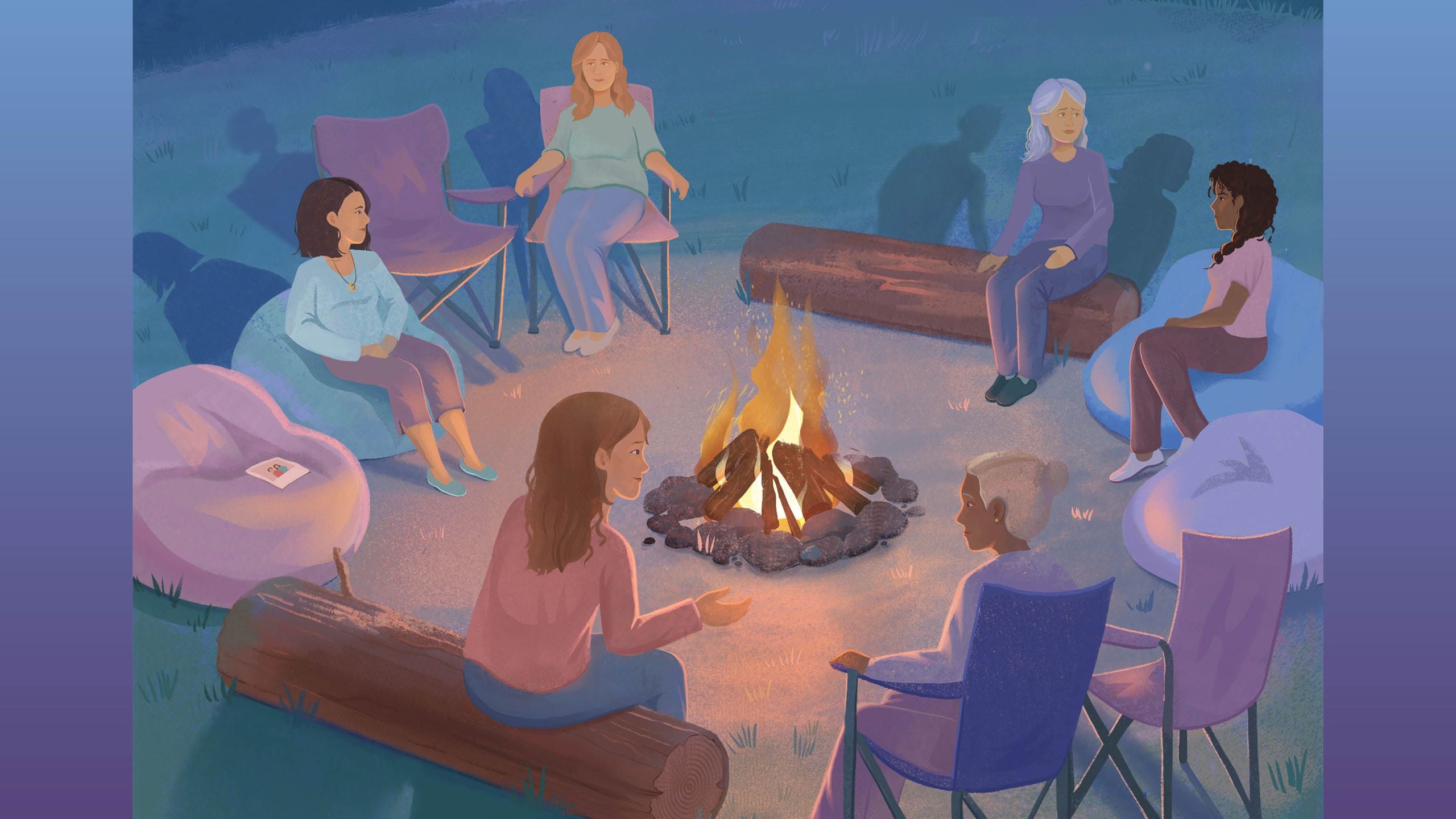
My Weekend At Camp Widow
IN JANUARY 2024, I lost my husband, Daniel, to a fentanyl overdose. We had been together for 27 years, raised two children and four dogs, bought a home and carved out successful careers. In all that time, I had no clue that he was an addict. Things started to fall apart in early 2023, when, in a horrific sequence of events, I became aware of his substance use, his serial infidelity and his habit of emptying our savings and retirement accounts. For the entirety of our marriage, he had been living a double life. We separated in March and I filed for divorce in May. I was still trying to wrap my head around the multiple betrayals when the police showed up at my door to tell me that he was dead.
Processing so much loss is a near-impossible task. First there was the loss of the man I thought I knew, then the loss of our marriage and our future and then, 10 months later, the loss of my children’s father.
Throughout this time, I was lucky to have a supportive network of friends and family. But still, no one really understood what I was going through. I found myself repeatedly needing to explain my situation—yes, he was an addict; no, I had absolutely no idea. On top of that, there was the stigma that surrounds losing a loved one to addiction. When I told people that Daniel died of an overdose, two of the most common reactions were shock and disbelief that I hadn’t known.
Then I learned about Camp Widow. The annual three-day event is hosted by Soaring Spirits Canada, an organization that helps bring widowed people together. Finally, I thought, a chance to meet other women with whom I wouldn’t have to do so much explaining.
I headed to Toronto on a windy day in June and found myself in a generic hotel near Toronto’s Pearson International Airport, surrounded by 215 others who had also lost a spouse. I wasn’t sure what to expect. When I thought of a camp for widows, I envisioned tents, bunk beds and a bunch of sad people sitting around a campfire. Fortunately, this hotel had comfortable beds and a bar that served decent margaritas. The same weekend, it was also hosting a bodybuilding convention, creating a peculiar mix of mostly women over 40 and young, shirtless and oiled-up bodies eating their macro-friendly lunches in the lobby.
Waiting my turn at the registration desk, I glanced over at the merch table (yes, Camp Widow has merch) and saw a T-shirt that read: “My partner ghosted me.” I laughed out loud and decided to let go of all expectations for the weekend.

I KNEW HEADING into camp that my situation was unique; I wasn’t just grieving Daniel, but the person I thought Daniel was: a fiercely loyal husband, a wonderful father and always the smartest person in the room. Daniel’s substance use made it painfully clear that I never really knew him. By the end of his life, he was so deep into his addiction that his personality was unrecognizable to me. He had turned aggressive and manipulative, and for the first time in our relationship, I was physically scared of him. When he died, I experienced a horrifying sense of relief that I couldn’t talk to anyone about.
“Grief in widowhood is uniquely complex and layered,” says Yadira Sosa, a group facilitator at the American addictions recovery nonprofit Herren Project. Widowhood as a result of addiction is even more complex. “There’s a sense of grief even before they pass, especially if there’s been a lot of ups and downs and trauma,” she says. “The network of people who understand this is very small.”
I was hoping to find that network at Camp Widow. Funded by donations, sponsorships and registration fees—the three-day retreat costs $675, plus accommodation—the camp offers community with people who understand the grief that comes with losing your person. Camps have been running annually in Toronto since 2014, progressively growing in attendance (this year, the event changed locations to accommodate more campers). In 2026, the organization is launching a second event in Calgary. The goal, according to Stacey Brown, chair of Soaring Spirits Canada and a widow herself since 2011: “To reframe widowhood as a collective, collaborative process through which people grieve, connect and thrive.” I had heard about post-traumatic growth, but until that weekend, I’d yet to see a firsthand example of it.
This type of immersive experience can be incredibly helpful with that growth, says Sosa. “Instead of one hour a week [in therapy or grief groups], you spend hours and days focusing on yourself and your grief surrounded by people who have similar emotions.”
Community-building is baked into the structure of Camp Widow and campers are encouraged to attend sessions based on where they are in their widow journey. Some attendees—most of whom are women—come just weeks after losing their partner; some have been widowed for more than 15 years. Nearly half of the attendees at the Toronto event were returning campers. No matter your situation, there is no need to explain why you’re exhausted, confused or suffering from “widow brain”—a constant fog that follows you everywhere. Most importantly, there is no one telling you it’s time to move on, a common sore spot for attendees.
Jessica Waite, author of the memoir The Widow’s Guide to Dead Bastards, was one such attendee in 2016, about a year after her husband died. Waite discovered after his death that he, like Daniel, had some secrets, including long-term infidelity.
“I knew everyone else [at Camp Widow] would be really missing their spouse,” she says. “And me? I was still pretty mad.” But she went because she realized that the first year likely wouldn’t be the hardest—instead, it’d be the years that followed. “I knew I needed a different strategy,” she says. “With the physicality of having hundreds of other widowed people around, I finally knew I wasn’t alone. You can know it intellectually, but until you’re there, you don’t feel it. There was such solidarity.”
Waite made lasting connections at Camp Widow—she still keeps in touch with some of the people she met—and left with a renewed sense of hope. Being with both new and long-time widows gave her a fuller picture of grief and the ways to move forward. “But perhaps most significantly, it helped me understand the math of grief,” she says. “It never added up for me. On one hand, it’s 100 percent a personal loss, but it’s also 100 percent a universal experience. [After Camp Widow], I was able to let go of some of what I was holding personally and let it flow into the universal.”
Throughout the weekend, I too was welcomed into the Camp Widow community. Complete strangers approached me, introduced themselves and invited me to join them for a meal or to sit beside them during a session. I tried to meet as many people as I could, searching for someone who had also lost their loved one to addiction.
On day two, I attended a session about processing complicated grief as a result of suicide or substance use, led by Dr. Jennifer Vriend, an Ottawa-based clinical psychologist. There were roughly a dozen people in that room, but all of the other attendees had lost their partners to suicide. I was convinced that I was still alone—until Vriend stood up and told her story. It was eerily similar to mine: she married the “perfect man,” who later developed a substance use problem. He died after they separated.
When we were invited to share our experiences, I raised my hand and spoke about how Daniel’s addiction destroyed our family, the conflicted feelings I had when he died and the mess he left behind. Vriend blinked. “Are you Julie?” I nodded. “I’m so glad you’re here,” she said. “Everyone has been telling me I needed to meet you.”

I HAVE BEEN carrying a lot of guilt for not seeing the signs of Dan’s addiction earlier. For not understanding that there were underlying causes for his behaviour. For being angry instead of compassionate. For making him feel abandoned when he likely needed me the most.
I’m also upset with myself for feeling this guilt, because I could only act on the information I had at the time. If Daniel had been honest with me about what he was going through, things might have gone differently. There’s a phrase in Nar-Anon, a 12-step program for those whose loved ones suffer with substance use, that I cling to religiously: I didn’t cause it, I can’t control it and I can’t cure it. Yet I still beat myself up for not trying harder.
Dr. Emily Blake, a Montreal-based psychologist who specializes in treating patients going through major life transitions, tells me that a great deal of preoccupation with a loved one’s death is the textbook definition of complicated grief. “It doesn’t naturally subside with life ‘going back to normal,’” she says. “If a loved one has died in a way that feels traumatic, upsetting or morally reprehensible, you might be stuck in a vicious cycle of pain and suffering.”
When a spouse dies from addiction, complicated grief can include struggling with difficult feelings and thoughts, whether it’s guilt, anger or relief. Blake stresses that all thoughts and feelings are okay to have, but that I should take note of what feelings emerge, when this happens and how I respond—then ask myself what these feelings tell me about my values, and how I want to move forward in life. For now, my main goal is learning how to be alone and trust my inner voice. After years of being gaslit and manipulated, this is the greatest gift I can give myself.

I WALKED OUT of my last Saturday afternoon session at Camp Widow just 10 minutes into the presenter’s speech. She was talking about hiking the Camino de Santiago, and how travel became an outlet for growth during widowhood. It sounded lovely, but I was overwhelmed trying to process the previous 48 hours. Drawn by the sound of laughter, I walked into the room next door, where Kelley Lynn, a Massachusetts-based grief counsellor, speaker and comedian, was doing a stand-up set about the widow experience.
“I hate when people refer to grief as a journey,” Lynn began. “When I think ‘journey,’ I’m thinking of a mediocre 1980s pop band, or a fun trip involving backpacks and adventures and friends and snacks. Grief has none of that. It crashes into your life, uninvited and fierce, knocking you off your feet and into the rubble. Grief is not a journey. Grief is a tsunami!”
I can’t even imagine what those bodybuilders must have thought, passing by that packed room and listening to a bunch of people who had gathered to talk about their grief howling and clapping.
That said, I wasn’t quite ready to dance. The previous night at the banquet, I stayed seated while some of my fellow widows let loose on the dance floor to songs like “Celebration” and “Man! I Feel Like a Woman!” But watching them find joy gave me something to hold onto.
Camp Widow didn’t cater specifically to my situation—other than Vriend, no one else I met that weekend had experienced what I had with their spouses. But it did show me that life will go on—and it will be fulfilling, even if that’s hard to recognize right now. “Seeing other widows thriving shows people what is possible,” says Brown. “It’s hard to have hope if you don’t know what to hope for.”
During the past 16 months, I’ve often hoped that Daniel has found his peace. Thanks to Camp Widow, I’m now thinking about what type of peace—and future—I might find for myself.


